

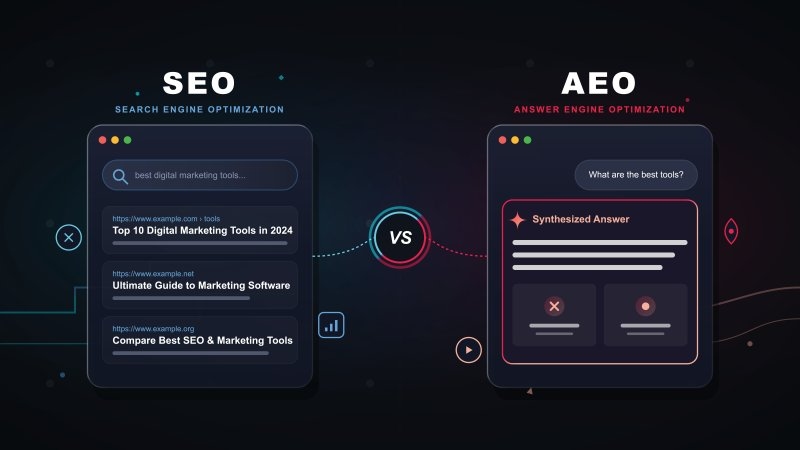
The approach to search has rapidly evolved. People no longer just type in keyword searches and have to go through numerous pages of results before finding what they want. They use AI-based services to ask their questions, compare their choices, and receive immediate replies. As a result, a new direction appeared that marketers should pay attention to – AEO vs SEO.
Although search engine optimization has been a basic part of any digital marketing strategy for years, answer engine optimization came about because of companies seeking ways to be a part of AI-generated responses. While SEO strategy involves efforts to increase website rankings and traffic, AEO involves attempts to become an answer provided by the AI system.
It is important to mention that AEO strategy will not replace SEO strategy as AI SEO. Businesses need to understand the role and specifics of each of the strategies to combine them effectively.
SEO is an abbreviation for search engine optimization and refers to the process through which a website’s content, structure, and authority is optimized to achieve a higher ranking in the results of traditional search engines. The primary goal of SEO is to gain organic visibility, attract visitors, and take a particular action such as registration, buying, or making contact.
For many years, businesses have been using SEO in order to boost their online presence. SEO includes several important factors, such as:
With good SEO, search engines can easily understand the meaning of your web page and why it should be ranked in certain queries. Thus, when people make searches and try to find something, they will most probably see optimized pages in the results.
Despite the fact that search technology is changing, SEO is still necessary. No matter how advanced the AI-powered platform is, it requires structured data to provide a correct response.
Answer engine optimization is the process of developing and organizing content in a way that allows AI-driven tools to effectively understand, extract, and deliver the information in the form of an answer to the question asked by a user.
Answer engines differ from regular search engines because their main purpose is not to display a set of links as a result but rather to deliver the answers to the queries.
The purpose of AEO is not only to ensure the ranking of a webpage but also its quality to get picked up as a credible answer.
AEO must be aimed at:
The growing popularity of generative engine optimization has also increased the significance of AEO since companies need to create content not only for people and search engines but also for AI-driven tools.
The primary distinction between AEO vs SEO is their objectives.
SEO is about improving the ranking of webpages in regular search engine results. Its objective is generally to get people to click through to a website.
As for AEO, it is all about improving the presence of content in an AI answer. Its objective is visibility in answers, summaries, and the answer search experience powered by AI.
Some of the primary differences include:
In SEO, the searches are based on keywords and involve an analysis of different results provided. For instance, the person who searches "best running shoes" needs to look at several options.
In AEO, the searches tend to be mostly questions with direct responses needed. For instance, if a person asks "What are the best running shoes for beginners?", they want to receive an immediate answer.
In SEO, content is usually rewarded if it is quite comprehensive and detailed. In this case, it will be long articles with optimized keywords, internal linking, and backlinks.
For AEO, the content structure should be adjusted to allow easier recognition by the AI. This means the use of clear headings, direct answers, FAQs, and organization of information.
The metrics used to measure the success of traditional SEO include: Keyword rankings, Organic traffic, Click-through rates, and Conversions. Success metrics in the case of AEO include: Answer mentions, AI visibility, Featured answers, and Brand mentions
Both strategies offer digital visibility.
There is no easy answer since both these techniques serve their own distinct purpose.
SEO still plays its part because the search engines remain the largest contributors to the traffic generated by a website. Failure to implement proper SEO techniques could mean failing to establish authority and visibility.
AEO has become equally relevant because of the changes that people make in their search queries. Rather than surfing through different pages of websites, today users expect AI systems to provide them with a quick summary.
The better way is to combine them both.
Companies that concentrate only on SEO could miss out on a new search trend, while those that focus only on AEO could be missing out on the basics of visibility and authority.
The balanced method of doing business would include:
The future of search would probably consist of both search engine optimization and AI-based answer generation systems.
In the business world today, it is not necessary for businesses to consider AEO vs SEO as two different strategies. In contrast, the two strategies should be integrated into one bigger strategy of increasing visibility where customers conduct searches.
A good integration of AEO vs SEO strategies for businesses involves developing content that would suit search engines, AI systems, and people who read the content.
While traditionally SEO strategies involved keyword-based practices, today it is important to understand what users want. Businesses should develop content that will answer the questions asked most often by their audiences.
Instead of focusing only on the keyword phrase like “digital marketing services,” businesses could develop content that answers the question of “How digital marketing services assist small businesses.”
AI technology requires precise information in order to provide correct answers. It is important that the information provided be structured using appropriate headings, paragraphs, bullet points, and explanations.
Incorporating FAQ content, how-to articles, and comparisons can increase AI visibility since such content allows for easy understanding by AI technology.
SEO and AEO require credibility just as much. Search engines as well as AI technology pay attention to credible information only.
The ways companies can boost their authority include:
Also Read: How Search Fundamentals Are Reshaped by AI Seo in 2026
With the evolution of AI-based searches, organizations must adjust their content strategies accordingly. Preparation of content for AI searches is now an important concern for marketers who want to remain relevant in the changing search environment.
Unlike regular search optimization, AI-based searches require content that offers comprehensive and meaningful answers and not just matching of keywords.
Here are some of the important ways to optimize content for AI searches:
AI search algorithms are meant to comprehend conversations. Content needs to contain clear answers to queries rather than making people search for answers within lengthy sections.
For instance, providing definitions or explanations at the start of sections will be of immense help for AI-based searches.
Users tend to communicate with AI tools in a conversational style. Text written in a conversational style will be more likely to match the way users ask their questions.
It is not about avoiding keyword usage. Businesses must use key terms in their content without sacrificing readability.
AI tools usually search for comprehensive pieces of content on a particular topic. Rather than creating separate pages with limited information, businesses need to create a comprehensive resource that answers questions around the topic.
Accuracy matters for any AI system. Any incorrect, outdated, or unsubstantiated facts will undermine your credibility. You should make sure to update your content often.
Most companies wonder whether they should go for SEO or AEO. The solution is that both approaches complement each other.
SEO establishes the groundwork by optimizing website authority, technical aspects, and discoverability of content. On the other hand, AEO capitalizes on the foundation laid by making the use of data more understandable and usable for AI algorithms.
Consequently, an SEO-optimized blog can achieve high rankings in organic searches because of the use of the right keywords, provision of valuable information, and the creation of backlinks. Nevertheless, the content can equally feature in AI-generated answers if the response is relevant to the query posed.
Thus, when implementing both SEO and AEO, companies can achieve better:
Digital marketing in the future will not consist of choosing between AEO and SEO but of developing content optimized for all search experiences.
Must Read: Content Creation: Build A Digital Career That Pays Well
It is not an issue of swapping one approach for another when it comes to AEO and SEO. SEO remains the cornerstone of online presence optimization, whereas AEO allows companies to adjust their approaches to the increasing role of AI in search.
The integration of search engine optimization, answer engine optimization, and proper AI search optimization allows for creating content that would reach consumers via various platforms. Companies that pay attention to clarity, relevance, and trustworthiness will have all the chances for success in the future.
To enhance AEO and SEO effectiveness, businesses must develop useful and relevant content that addresses users’ queries, incorporates the right keywords, ensures good technical performance of their websites, and organizes content.
To increase AEO and SEO visibility, it is necessary to create valuable and authoritative content, answer customers’ frequently asked questions, use a structured format, and keep the information updated. Keyword research, backlinks, and information provided may be helpful for both types of optimization.
To optimize the content for answer engines, it is important to develop sections that directly answer users’ questions in a conversational style. FAQ sections, accurate information, and structuring content may help the AEO process.
Content that provides explicit answers to questions is best suited for AEO. Examples include definitions, comparisons, how-to guides, FAQs, and other content types where the information is explicitly explained in straightforward ways.
No, AEO does not replace SEO but works alongside SEO. SEO can help your site achieve rankings, authority, and organic traffic, while AEO makes your content more valuable and visible in the AI-based and answer-centric world of search.
This content was created by AI